Drafts, working copies and secure exchange with the parties involved, in line with the Federal Chamber of Notaries' framework. #nobackdoor


With Circular No. 1/2026, the Federal Chamber of Notaries (Bundesnotarkammer) has for the first time set a clear framework for cloud use in notaries' offices: cloud is permitted, but only under strict conditions.
Under § 35 (4) BNotO, electronic records and registers belong in the notary's office or in the Chamber's Elektronischer Notaraktenspeicher, not in a cloud.
What the cloud is permitted for are auxiliary materials under § 35 (2) sentence 2 BNotO: draft files, working copies and backup copies, provided data protection and notarial secrecy are safeguarded.
SecureCloud does not replace the Chamber's electronic document archive, your notarial software or the beN mailbox. It closes the gap next to them: the so-far unencrypted email traffic around drafts and documents.
Notarial secrecy is professional law, not a mission statement. SecureCloud implements it technically: encrypted storage, access only to the extent required for the task at hand (§ 26a BNotO), and a confidentiality agreement in text form as a supplement to the data processing agreement.
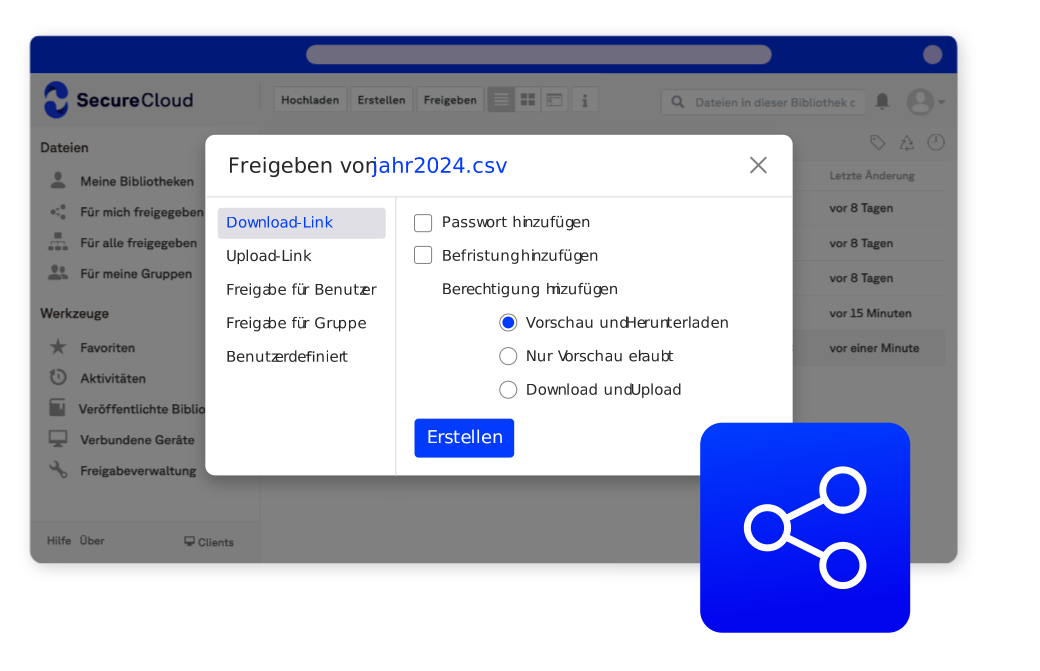
Instead of unencrypted email attachments you send share links with password and expiry date; ID copies and documents for your AML (GwG) checks come in through a protected upload folder instead of the open inbox. Data is secured with AES-256, an encryption considered resistant to attacks by quantum computers.


Attorney-notaries (Anwaltsnotare) satisfy two sets of professional law at once: attorney confidentiality under the BRAO and the notarial requirements of the BNotO. In SecureCloud you separate both mandates cleanly: separate libraries and separate permissions for attorney and notarial data, in one platform.
You assign access per person, folder and share, with passwords, time limits and black and white lists, adjustable and reversible at any time.
The Chamber requires auxiliary materials held in the cloud to be backed up locally in the office at least once a week. With the sync client, a complete copy of your libraries sits continuously on the office server and flows from there into your existing backup routine.
On the provider side, geo-redundant backups and virus scanning are added. And because the copy sits in your office, your notariat keeps working even if a cloud service is temporarily unreachable.


When moving to SecureCloud, not a single record file moves: records and registers stay in the notary's office or in the Chamber's Elektronischer Notaraktenspeicher. What moves are auxiliary materials such as drafts and working copies, plus the exchange with the parties involved.
In practice that means: set up the folder structure and permissions, install the sync client, upload the draft repository and test the sharing workflows. Your notarial software remains untouched.
Notaries' offices start with the free 14-day trial, from 2 users.
14 days free of charge and without obligation!
The Chamber requires notaries' offices using cloud services to safeguard data protection and professional secrecy: a data processing agreement under Art. 28 GDPR, technical and organisational measures under Art. 32 GDPR, access limited to what is necessary, and it recommends preferring European providers. SecureCloud meets the provider side of these requirements: a German company, data centers exclusively in Germany, ISO 27001 certified, BSI C5 attested; we provide the data processing agreement under Art. 28 GDPR digitally for signature, with documented TOMs under Art. 32. Classifying data as auxiliary materials and the weekly local backup remain the office's own duties; SecureCloud supports both but does not replace them.
Electronic records and registers must be kept in the notary's office or in the Chamber's Elektronischer Notaraktenspeicher under § 35 (4) BNotO; they do not belong in any cloud, including ours. The cloud is permitted for auxiliary materials under § 35 (2) sentence 2 BNotO: draft files, working copies and backup copies, provided secrecy and data protection are safeguarded. In practice: drafts, working versions of correspondence and secure exchange with the parties involved run through SecureCloud, while record-keeping stays where professional law requires it.
Instead of unencrypted email attachments, notaries' offices send share links with SecureCloud: encrypted, with password, expiry date and an optional download limit. Parties, banks or authorities get access to exactly the released file, or to an upload folder, without needing an account. Every share can be revoked at any time, and the audit log gives the office a traceable view of what was shared. The dispatch of drafts and documents stays under the office's control even after it has left the building.
The Chamber requires auxiliary materials held in the cloud to be backed up at least once a week to a server or storage medium in the notary's office, so operations continue even if cloud services fail completely. With the SecureCloud sync client you keep selected libraries as a complete local copy in the office, optionally running as a Windows service on the office server; that copy can be included in the existing local backup routine. Responsibility for the backup plan remains with the office.
Yes, the platform is designed for it. Access to information subject to professional secrecy can be limited to what the task at hand requires: per person, per folder, per share. For engaging a service provider under § 26a BNotO, SecureCloud provides the contractual basis: a confidentiality agreement in text form as a supplement to the data processing agreement, the DPA under Art. 28 GDPR provided digitally for signature, and documented technical and organisational measures under Art. 32 GDPR.
Attorney-notaries satisfy two sets of professional law at once: attorney confidentiality under the BRAO and the notarial requirements of the BNotO including BNotK Circular 1/2026. In practice that means a provider that separates the two mandates cleanly (separate libraries and permissions for attorney and notarial data), need-to-know access, a data processing agreement and confidentiality agreement, and a location that raises no third-country questions. SecureCloud maps both areas in one platform, with German data centers and granular permissions down to folder level, from 2 users.
Manageable, because there is no records migration: records and registers stay in the office or the Notaraktenspeicher anyway. What moves are auxiliary materials such as drafts and working copies, plus the exchange of documents with parties involved. The typical sequence: set up the folder structure and permissions, install the sync client in the office, upload the existing draft repository, test the sharing workflows. Notaries' offices start with the free 14-day trial and can begin small, from 2 users, without replacing their existing notarial software.
No, deliberately not. The Urkundenverzeichnis and the electronic document collection are kept in the Federal Chamber of Notaries' own systems, communication with courts and authorities runs through the special electronic notary mailbox (beN), and your notarial software remains the specialist system. SecureCloud closes the gap next to them: encrypted storage for auxiliary materials under § 35 (2) sentence 2 BNotO and the exchange of drafts and documents with the parties involved, which today mostly runs over unencrypted email. Both complement the existing systems rather than touching them; all data resides exclusively in German data centers.
Data centers and company headquarters in Germany
Our promise: #nobackdoor